Electric Motor Repair vs. Replace – Costs, Contingency Planning & Sustainability
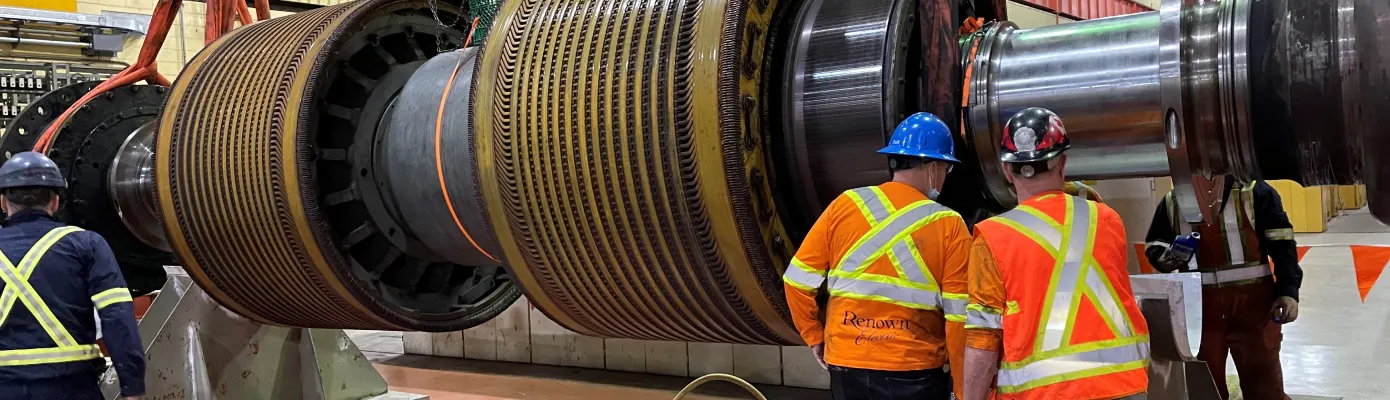
When an electric motor fails, the repair-or-replace call can save or cost thousands of dollars, and far more if the motor is critical to production. The direct price of a rewind or a new unit is only part of it. Downtime, lead time, lifetime energy use and what happens to the old motor all shape the true cost.
More operations now also report on carbon and waste. That makes the environmental side of repair vs. replace a business question, not just a good-citizen one. The best answer comes from weighing all of these together, ideally before a failure ever happens.
Should You Repair or Replace Your Electric Motor?
No single factor decides it. Use the table below as a checklist, then run a cost-benefit analysis that covers both the short and long term. Regular preventative maintenance remains the most reliable way to keep these decisions rare, since poorly serviced motors are a common cause of early failure.
| Factor | Leans toward repair when… | Leans toward replacement when… |
|---|---|---|
| Repair cost | Repair is below your threshold. The traditional rule is 50% of new, but some sites now repair up to 85% when a rewind can hold or improve efficiency | Repair exceeds your threshold, or a rewind cannot restore the motor’s efficiency |
| Extent of damage | Wear is limited to bearings, brushes, capacitors or a single winding failure | The core, frame or shaft is badly damaged, or windings have failed repeatedly |
| Motor age and history | The motor is mid-life with a clean service record | Motor age and history The motor is mid-life with a clean service record It is near end of life or has a pattern of recurring faults |
| Lead time and downtime | A rewind can be turned around faster than a new unit can be sourced | A suitable new or spare motor is on the shelf and downtime is very costly |
| Parts availability | Parts are stocked or can be manufactured in-house (coils, shafts, housings) | The motor is obsolete and parts would require extensive custom work |
| Energy efficiency | The motor is already high-efficiency and will be repaired to good-practice standards | A new motor would be meaningfully more efficient, especially on a high-duty application |
| Performance needs | The repaired motor still meets output and efficiency requirements | The application has changed or needs features (e.g. drive compatibility) the old motor lacks |
| Warranty | It is still under warranty | Not applicable |
| Sustainability | Preserving the motor’s embodied carbon and avoiding scrap matter to your targets | Lifetime energy savings from a more efficient motor outweigh the impact of making a new one (see below) |
When in doubt, ask for an expert assessment. Motor technicians can test the core, windings and mechanical condition and give you a defensible basis for either choice.
Sustainability: Waste vs. Reuse
Repairing a motor usually keeps tonnes of steel, copper and cast iron in service, but it is only the greener choice if efficiency is protected. The environmental case rests on two things that pull in opposite directions: the carbon locked into making a motor, and the electricity it burns over its life.
The case for reuse: embodied carbon and waste
Every new motor carries embodied carbon from mining, smelting, casting, winding and shipping. A 2024 study by Newcastle University with Houghton International, published by the AEMT, found embodied carbon made up roughly half of total global warming impact in the scenarios it modelled. Repair preserves most of that investment.
- Less material demand. A rewind replaces the winding copper and insulation but reuses the frame, stator core, rotor, shaft and end bells, the heaviest and most carbon-intensive parts.
- Less scrap. A replaced motor becomes waste to be hauled, dismantled and recycled, and recycling itself uses energy and loses some material.
- Lower transport impact. A local repair avoids shipping a new unit from an overseas factory.
- Circular-economy alignment. Repair, remanufacture and reuse of components support corporate waste-reduction targets and ESG reporting.
The catch: efficiency drives lifetime impact
For large, hard-working motors, the electricity used over 20 or more years dwarfs the impact of manufacturing. Chalmers University research on high-voltage motors found that energy losses during use dominated both carbon and resource-depletion impacts. In its sensitivity analysis, an efficiency loss of more than about 0.4% after a rewind was enough to outweigh the benefit of not building a new motor.
The lesson is not “always replace.” It is that a repair must not degrade efficiency. Independent testing in the EASA/AEMT rewind studies, first in 2003 and again in 2019 on premium-efficiency (IE3) motors, found that good-practice rewinds caused no efficiency change beyond the ±0.2% accuracy of the test method. Done properly, repair delivers the material savings without the energy penalty.
This is why a fixed 50% replacement rule can work against sustainability goals. When a rewind holds or improves efficiency, paying more for repair keeps a motor’s embodied carbon in service. Some Renown customers now repair up to 85% of the cost of new for exactly this reason (see the FAQ below).
Putting it into practice
- Specify good-practice repair. Ask for work to ANSI/EASA AR100 and the EASA/AEMT Good Practice Guide, including controlled burn-off temperatures and core-loss testing before and after.
- Compare lifetime energy, not just purchase price. For high-duty motors, estimate annual kWh at the old and new efficiency. A one- or two-point gain on a large, continuously running motor can outweigh repair savings.
- Repair-and-upgrade where possible. Upgrading to better bearings, insulation or a redesigned winding during a rewind can extend life and hold or improve efficiency.
- Retire responsibly. When replacement wins, send the old motor for proper dismantling and metal recycling, or keep it as a rebuilt spare.
- Track it. Record kWh, scrap avoided and repair vs. replace outcomes so sustainability reporting reflects real results.
Make the Decision Before the Failure: Contingency Planning
The worst time to weigh repair against replacement is during an unplanned outage, when downtime pressure pushes toward whatever is fastest. A contingency plan settles the question in advance, so the choice is made on cost, risk and sustainability rather than panic.
For critical assets the stakes are large. On a 10,000 HP motor, an unplanned repair cycle can run about 45 days; a validated plan with pre-staged parts and logistics can cut that by 30% to 40%, to roughly 27 days or less. See Renown’s contingency planning approach for the full breakdown.
A good plan answers the repair-or-replace question asset by asset:
- Rank critical assets. Identify motors and generators with no installed redundancy and estimate the daily cost of losing each one.
- Pre-decide the path. For each, record whether a failure will trigger repair, replacement or a swap to a spare, and the cost and efficiency thresholds that would change that call. Many sites now set the cost threshold well above the traditional 50%.
- Secure the long-lead items. Coils, bearings, RTDs and shafts for large OEM motors can take 6 to 18 months to source. In-house coil manufacturing and CNC shaft machining keep repair a viable, faster option.
- Collect the data now. Winding schematics, outline drawings and maintenance history speed the repair and make an efficiency-preserving rewind easier to verify.
- Plan logistics. Define rigging, cranes, transport and permits so removal does not become the bottleneck.
- Build sustainability into the plan. Favour rebuilt spares and repair-and-return pools over buying new by default, and set an efficiency floor below which a repair is not accepted.
A rebuilt spare on the shelf is often the best of both worlds: near-zero downtime when a failure hits, and no new motor manufactured to get it.
How Renown Electric Helps
Renown Electric helps customers repair, rebuild and plan around their most critical rotating equipment, extending service life while protecting efficiency. Our 60,000 sq. ft. facility in Concord, Ontario handles full diagnostics and repair:
- Motor, generator and gearbox rewinding and rebuilds
- In-house coil manufacturing and machine shop services, including shafts and housings
- Servo motor, motor drive and pump repair
- Sheave regrooving and manufacturing
In addition to in-house repairs, we provide a full range of on-site field services for customers across Canada.
Our preventative and predictive maintenance services, including vibration analysis, infrared thermography, motion amplification, winding analysis, laser alignment, dynamic balancing and oil analysis, catch problems early so repairs stay small. Through contingency planning and our Total Care Support Plan, we help you decide in advance which assets to repair, rebuild or replace.
Quality You Can Trust
Renown Electric Motors & Repair Inc. is committed to providing our customers with the best quality of services and products, which is why we work hard to maintain our many certifications:
- ISO 9001:2015
- Electro-Mechanical Authority (EASA) Member
- Electrical Safety Authority (ESA) Member
- Canadian Standards Association (CSA) Qualified for the Repair and Service of Motors and Generators in Hazardous Locations
- ISN-Compliant
- EXIROS-Compliant
- QUAREM-Compliant
- ISNetworld
- Cognibox
- Avetta
- Contractor Compliance
- Contractor Check
| Not sure whether to repair or replace? Contact us or request a quote, and our team will help you weigh cost, downtime and environmental impact for your motor and facility. |
FAQ: How do you evaluate electric motor repair costs versus buying a new motor?
The traditional guideline is the “50% rule”: replace a motor once repair costs more than half the price of a comparable new one. That rule counts only the purchase price. It ignores downtime, lead time, embodied carbon, scrap, and whether a rewind can match or even beat the motor’s original efficiency.
When a motor can be rewound to good-practice standards, or a rewind can be engineered to improve efficiency, repair can make sense up to 85% of the cost of new. Some Renown customers have moved their threshold to 85% to achieve their sustainability targets, with no negative impact on their operations.
A lower threshold still makes sense for small motors (roughly under 5 to 10 HP), where rewind labour approaches the price of a new unit; for motors with a damaged core or frame; and where a new motor offers a large efficiency gain on a high-duty application. When replacement wins, recycle the old motor properly rather than sending it to landfill.
Sources:
- Renown Electric: Electric Motor Repair vs. Replace (original post)
- Renown Electric: Strategic Contingency Planning
- AEMT: Comparing the environmental impact of repairing versus replacing electromechanical assets
- Chalmers University: When is repair environmentally beneficial? The case of high-voltage electric motors
- EASA: The effect of repair/rewinding on Premium Efficiency/IE3 motors
- EASA: How to ensure effective motor repair and rewind